A Summer Palace for the Afterlife
The Tomb of Tu Duc is probably the "one to see" if you only have limited time. It is the closest to Hue of the larger, more impressive tombs. The tomb is an enormous walled enclosure, practically a palace in its own right. In fact, the guidebooks and plaques on the walls will tell you that the emperor spent a lot of time here during the tomb's three years of construction. It seems likely that the tomb site served as a sort of summer palace.
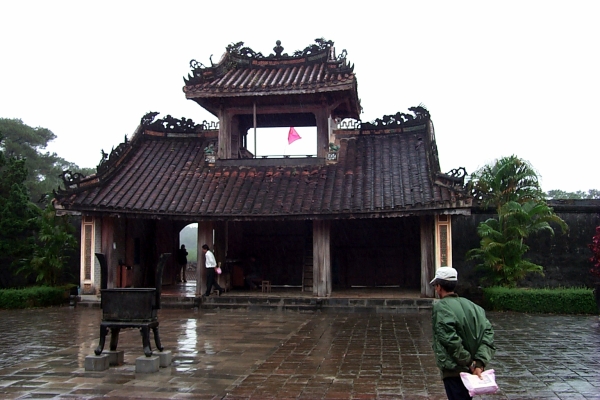 The entrance to the palace cum temple cum tomb
To your right as you enter through the gate is a large meandering lake. There's a small island in the middle, reputed to be where the emperor is really buried. Facing the largest open area of the lake is a wide grand staircase. This leads, not to the tomb, as you might expect, but to a temple which was used as a palace by the emperor before his death.
At the top of the stairs, you pass through a gate into a courtyard. On the other side of the court is a smaller version of the Long An palace, used as a temple after the emperor's death. Inside is now a museum containing a few interesting artifacts, such as a mirror used by the courtesans. Behind the temple hall is another courtyard, this one fully enclosed. The hall to the right was, surprisingly, built as a theater. Opposite this was a hall used by the mandarins of the court, while at the back is the emperor's private residence.
Back through the gate and down the stairs, paths lead in a couple of directions through the hills and trees of the compound. These paths lead to several tombs, as much of the emperor's family are buried here.
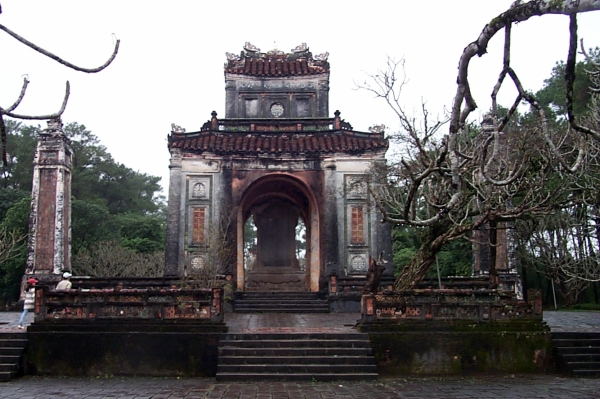 The stele carved with a tribute to the emperor, written by the emperor, in a stone pavilion
The emperor's own tomb is right next to the palace/temple complex. In common with all the tombs, there is a stele inscribed with the emperor's accomplishments. Tu Duc's is the largest in Vietnam, weighing 20 tons. He wrote the inscription himself. In his defense, Tu Duc was the longest reigning monarch of the Nguyen Dynasty.
Behind the stele, on the other side of a small pond, is the enclosure containing the king's sepulcher. But, as alluded to above, Tu Duc was never actually interred here. He was buried somewhere else to deter grave robbers.
Be sure to explore the other tombs, following the path around the lake. Its a very peaceful setting. The entrance fee to the tomb is 55,000 Dong (-55,000.00 USD).